Victorian lampshades are often described using terms not commonly used in modern retail lighting. Words such as panel, trim, fringe, lace, and beadwork refer to visible features of the finished piece. For someone encountering Victorian lampshades for the first time, the terminology can feel specialized.
The explanations below clarify how these terms are used in the context of Victorian lampshades and what they describe in a completed work.
For broader historical context, you may also explore The Enchanting World of Victorian Lampshades.
Most mass-market shades today are identified primarily by overall shape, such as drum or empire. Victorian lampshades are described differently. The terminology surrounding Victorian lampshades reflects structure, surface detail, and material relationships rather than overall silhouette.
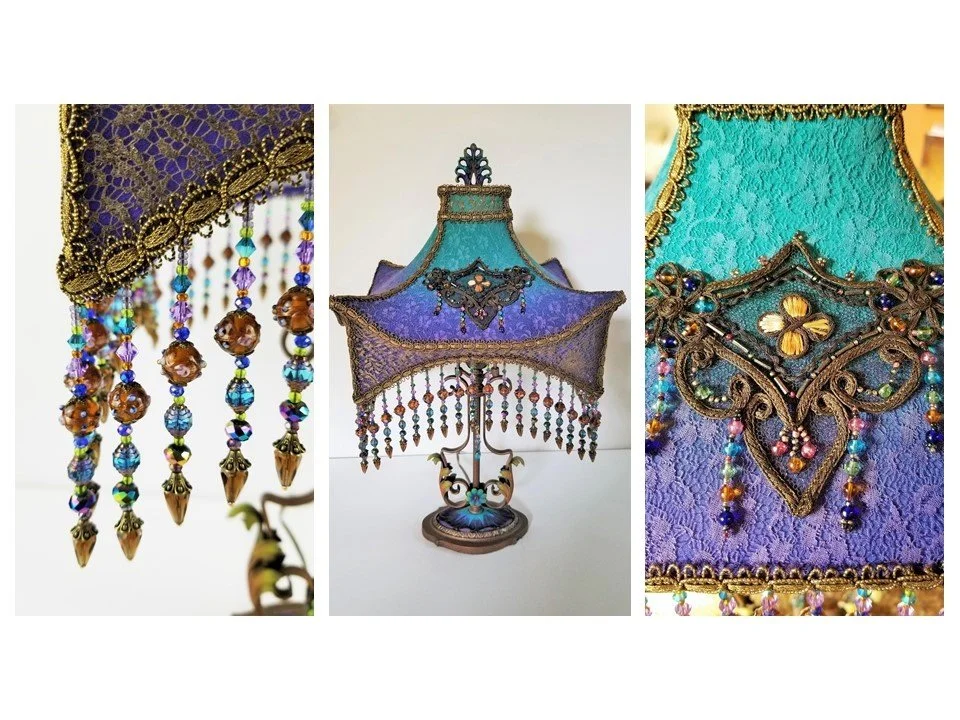
Above: Example of a Victorian lampshade showing panel structure, lace overlay, decorative trim, and hand-strung bead fringe.
The terminology most often used to describe Victorian lampshades includes ribs, panels, trim, fringe, lace, beadwork, color, frame structure, and the fitter.
The most common structural and decorative elements found in Victorian lampshades include the following:
Rib
A rib is a wire element of the lampshade frame that helps define the underlying shape and structure of a Victorian lampshade. Ribs may run vertically, horizontally, or along curved and circular paths depending on the design of the frame.
Because the fabric follows these ribs, they help determine how the surface of the shade is divided and how decorative elements align across it.
Panel
A panel is a distinct section of a Victorian lampshade surface defined by structural boundaries. Panels may vary in proportion or orientation, but what distinguishes them is containment. Each panel creates its own field of fabric.
Panels introduce rhythm and visual order. Even when richly detailed, panel-constructed Victorian lampshades maintain clarity because the surface is intentionally divided. This differs from many contemporary drum shades, which present a continuous surface without internal segmentation.
Trim
Trim is decorative edging that follows the structural lines of Victorian lampshades, often emphasizing seams or ribs. It defines transitions between materials and clarifies geometry.
Trim is frequently confused with fringe. Unlike fringe, trim does not extend beyond the perimeter of the shade. Its purpose is to define and refine the structure already present.
Fringe
Fringe is a decorative element that extends from the lower edge of a Victorian lampshade and becomes part of its overall proportion. It may appear soft and fluid, structured and uniform, reflective and faceted, or lace-like and dimensional.
Fringe contributes movement or visual interest when present. In Victorian lampshades, it can repeat color, introduce rhythm, or subtly shift the balance between shade and lamp.
Fringe may also be omitted entirely. Its presence is intentional.
Lace
Antique lace is historically produced lace used as an overlay or applied surface element in Victorian lampshades. Different lace traditions vary in density, ground structure, and threadwork.
Some lace appears delicate and open. Other lace appears dimensional, with raised or corded elements that create relief. Beaded lace incorporates reflective detail, altering both texture and shadow.
In Victorian lampshades, lace interacts directly with illumination. Fine grounds soften light gently. Heavier structures create deeper shadow and dimensional contrast.
Beadwork
Beadwork is decorative bead ornament that may appear as part of trim, integrated into lace, or suspended as fringe. In Victorian lampshades, bead density and placement influence how the lower portion of the shade appears in both daylight and artificial light.
Sparse beadwork introduces subtle movement. Denser beadwork increases visual weight and produces sharper shadow and reflection.
Beads influence perception as well as ornament. For further insight into studio beadwork, explore The Art of Handstrung Beads.
Color
Color in Victorian lampshades refers to the way hue, value, tone, and saturation interact with illumination. Hue refers to the color family itself. Value refers to lightness or darkness, which influences perceived weight under illumination. Tone describes a color moderated by gray, often appearing more subdued and complex. Saturation refers to intensity.
Under different light temperatures and intensities, these qualities shift. Deeper values absorb more illumination and feel grounded. Lighter values reflect more light and expand presence. Highly saturated colors intensify under strong light, while moderated tones remain controlled.
An ombré effect is a controlled transition from one hue or value to another across the silk surface. This transition alters how Victorian lampshades appear from top to bottom and how light moves across them.
For a broader discussion of color and visual impact, see The Impact of Lampshade Color in Home Furnishings
Color in Victorian lampshades responds to illumination rather than remaining static.
Frame Structure
Frame structure refers to the underlying wire frame that establishes the shape and proportions of a Victorian lampshade. The frame establishes proportion and contour. Silk, lace, trim, and fringe are arranged in relation to that form.
Structure describes how those materials follow the wire frame and preserve its intended lines. When structure is handled with care, ornament feels composed rather than excessive.
Careful structure allows detail to enhance Victorian lampshades without overwhelming them.
Fitter
The fitter is the metal component that allows a lampshade to attach to a lamp. It determines how the shade is supported and positioned above the light source.
Different fitter styles exist, including spider fitters, clip fitters, and UNO fitters. Each style connects to the lamp in a different way, affecting both stability and vertical placement.
In Victorian lampshades, the fitter must align carefully with the shade’s proportions so that the shade rests at the intended height relative to the lamp base.
Victorian Lampshades as a Whole
Understanding this terminology changes how Victorian lampshades are perceived.
Instead of seeing isolated decorative elements, you begin to recognize how panels create order, how trim defines structure, how fringe contributes movement, how lace introduces surface depth, and how color responds to illumination.
When these elements are considered together, a Victorian lampshade reveals its balance of structure, material, and light.
If you would like to view available work, explore the current collection of Victorian lampshades.

About the Author
Crystal Hayes, Owner and Lampshade Artist at Elegance Lamps
Seattle, WA USA
Crystal Hayes is a Seattle-based artist and maker inspired by the natural beauty and creative culture of the Pacific Northwest. She designs and handcrafts one-of-a-kind Victorian lampshades, often pairing them with restored antique lamp bases to create functional works of art for everyday living.
Each piece is made entirely by hand, from initial design through final construction, with close attention to materials, structure, and long-term durability.
See the Current CollectionsElegance Lamps on Social MediaFollow Elegance Lamps on social media for new work and studio updates.
See the Elegance Lamps BioSite for more.
Contact Elegance Lamps
ELEGANCE LAMPS VICTORIAN LAMPSHADES AND ANTIQUE LAMPS
Where beauty meets functionality.
Please use the social sharing buttons below to share this post. Thank you so much! Feel free to leave a comment. You do not need to enter your email address or website.